
Twelve Dollars Until Midnight
The Hidden Math of Their Budget Failed Today’s World

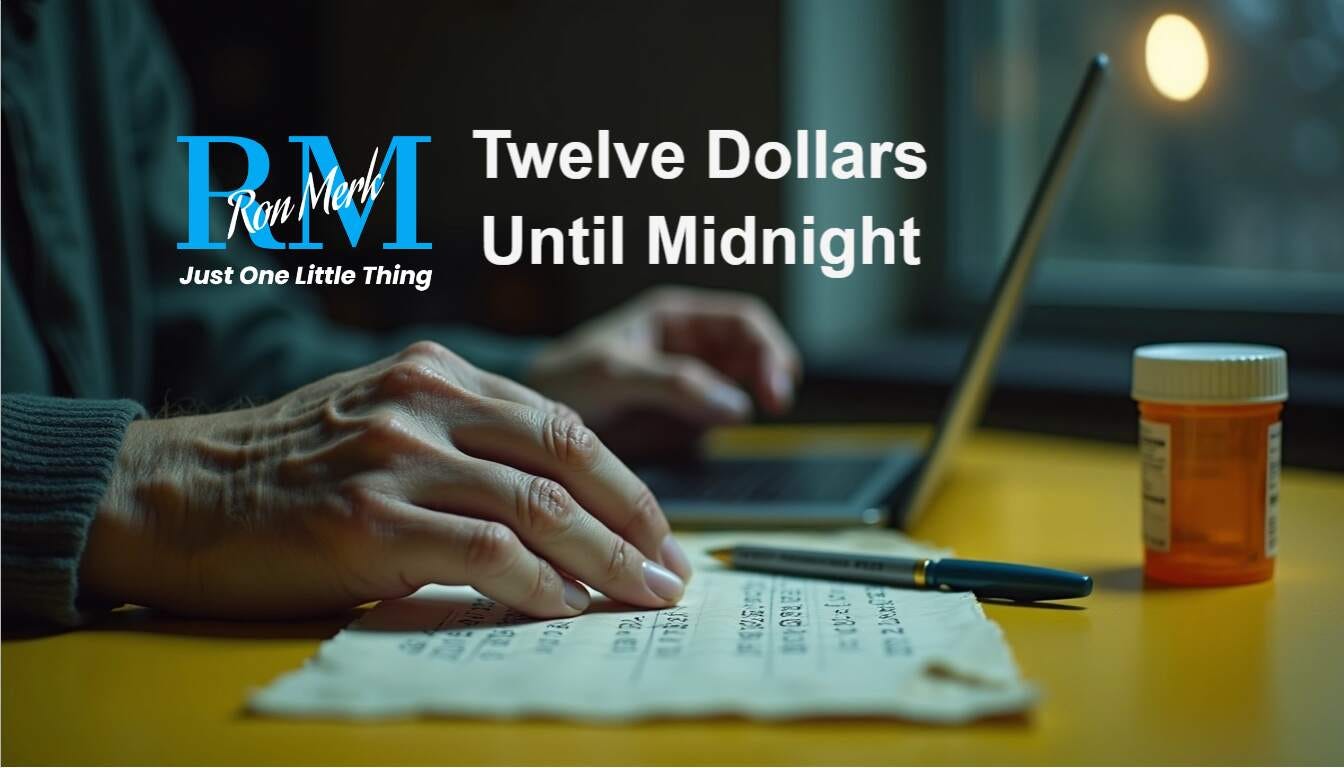
We like to pretend that hard work is enough, but the modern world doesn’t care about your budget ledger. Arthur is down to exactly twelve dollars and forty-two cents until his midnight pension deposit drops on Thursday. A quiet, humiliating calculation he has hidden from his family behind a lifetime of stubborn pride. That’s when a wet drizzle forces him into a three-mile trek to save gas money, a chance encounter in a pharmacy aisle and a sudden domestic crisis at home strip away his final illusions of control. Twelve Dollars Until Midnight is a deeply moving exploration of the quiet economic tightrope so many families are walking today. The crushing weight of a man’s secret shame, and the profound moment necessity forces a choice between pride and the people he loves.
Part 1: The Calculations of Month-End
The online banking screen was a flat, unblinking grey in the kitchen dawn. Its small digital integers refused to budge, no matter how many times Arthur adjusted his reading glasses. The balance was twelve dollars and forty-two cents. On the yellowed Formica table beneath the tablet, a cheap ballpoint pen with a chewed cap sat beside a scrap sheet of paper torn from an old hardware store ledger. Arthur didn’t need to write the numbers down anymore because the arithmetic of survival had carved itself into his mind forty years ago. It was back when the labour disputes and seasonal layoffs at the mill used to threaten food for his family, but the physical act of tracing the figures gave him the illusion of authority. He felt that if he pressed the pen hard enough into the paper, the three-dollar discrepancy between his memory and the machine would simply dissolve.
It was Tuesday morning, exactly forty-eight hours before the federal pension deposit would drop into their account at midnight on Thursday. In the quiet house, the only sound was the low, rhythmic rattle of the old refrigerator in the corner and the steady, heavy sigh of the June rain against the windowpane. Outside, the Beaufort Range was entirely swallowed by low-hanging cloud. The mist trapped the dampness of the Alberni Inlet right down to the pavement of Johnston Road. Arthur looked down at his calloused thumbs. The skin was permanently stained around the knuckles from decades of grease and cedar bark. He’d given forty-two years to the timber of this valley. He’d believed with the stubborn certainty of his generation that a lifetime of heavy lifting bought a man the right to an unhurried old age. Instead, he was seventy-six years old and treating the price of a standard bottle of blood pressure medication like a tactical maneuver in a war he hadn’t realized he was fighting.
The bedroom door clicked open behind him, and the sound was sharp in the stillness. Arthur instinctively dropped his hand over the scrap of paper. His fingers curled to obscure the pencil marks as Martha shuffled into the kitchen. She looked small in her faded blue housecoat. Her shoulders were curved by the damp cold that always seemed to find its way through the floorboards of the old bungalow this time of year. She didn’t look at the tablet or the paper because she didn’t have to. She’d lived with him long enough to recognize the specific, rigid posture of his spine when he was trying to outmaneuver the calendar and their bank account.
“The kettle’s just about through, Art,” she said softly. Her voice carried the gravel of early morning as she reached for the two ceramic mugs by the sink. They were the ones with the chipped rims they’d kept since the kids were small. “Did you want the last of the Nabob, or should I save it for tomorrow?”
“Go ahead and make it,” Arthur said. He forced his voice to settle into a casual, steady rhythm that felt entirely foreign to the knot in his stomach. “We’re fine for coffee. I’ve got to head down to the pharmacy anyway after a bit to pick up your renewal. I’ll grab a tin then.”
It was a lie, and they both knew it, though Martha simply nodded and turned back to the stove. The Nabob was eight dollars on sale at the Quality Foods, and eight dollars didn’t exist in the twelve-dollar reality of Tuesday morning. To get the prescription, he’d have to use the remaining balance on the Shoppers Drug Mart gift card his daughter Jean had given him for his birthday back in March. It was a card he’d hidden in the back of his sock drawer like contraband, specifically saved for a week like this. He’d told Jean then that he didn’t need it and that his pension covered everything they required with room to spare. To admit otherwise was to admit that the world he’d built had slipped out from under him. It left him feeling as vulnerable as a green apprentice on his first day in the woods.
When Martha took her tea back into the living room to watch the early news, Arthur remained at the table. He stared at the grey screen until it timed out and went black, reflecting his own lined face back at him. His misbelief was a heavy, invisible garment he wore every day. He believed that as long as the budget didn’t break out in the open, and as long as he bore the scarcity in silence, he was still the provider. But the edges of that garment were fraying. The old Buick out in the carport had less than an eighth of a tank left, which wasn’t enough to risk the drive to the pharmacy and back if the fuel light came on. He’d have to walk the three miles to Shoppers Drugstore in the drizzle. He’d let the coastal damp soak through his old canvas jacket just to preserve the five dollars’ worth of gasoline for an emergency.
He pulled the Shoppers Drug Mart card from his pocket and turned the plastic over in his rough palm. The numbers on the back were small and clean. He’d spent his youth clearing first-growth timber from the ridges above this town, working in the kind of terrain where an error of six inches meant a log would crush a man’s chest. He’d never been afraid of the work, and he’d never been afraid of the mountain. But looking at the plastic card in his hand, knowing he was down to forty-eight hours of thin ice, he felt a cold, modern kind of dread that didn’t have a name. It was the quiet panic of a man who’d done everything he was supposed to do, only to find that the modern world didn’t care about the ledger of his past, or his pension problems.
Part 2: The Weight of the Valley
The drizzle didn’t fall so much as it drifted, a fine, cold shroud that blurred the edges of the duroid shingled roofs along Gertrude Street Road. Arthur walked with his chin tucked into the collar of his canvas jacket, his hands buried deep in his pockets. Every few steps, his hip gave a dull, familiar throb, a souvenir from a winter night on a logging road thirty years back when a trailer hitch had snapped. Normally, he’d take the Buick, letting the heater clear the fog from the glass while he listened to the local radio. Today, he kept his eyes on the sidewalk, measuring his progress by the driveways he’d known for half a century. He passed the old Miller place, where the lawn was overgrown now, and the small, sagging bungalow where a fellow trimmer from the mill used to live. The valley didn’t look old so much as it looked tired, like an engine that had been run too hard for too many shifts and was finally cooling down to a permanent grey quiet.
By the time he reached the lower stretch near the Rodger Street intersection, the scent of the tidal flats was thick, mixing with the faint, sour tang of the remaining mill chimneys of the Catalyst Paper Mill. The town had changed its skin around him while he wasn’t looking. The old hardware store where a man could buy single brass screws and talk about the salmon run was gone, replaced by a boutique selling locally made candles and soaps to tourists passing through on their way to the West Coast. He felt like a ghost walking through a museum of his own life. The modern world had arrived with its smooth surfaces and tap-to-pay terminals, but it hadn’t brought any more certainty than the old days of the seasonal layoffs and strikes. It had just made the struggle quieter, hiding the poverty behind clean storefronts and digital bank screens that a man couldn’t see unless he had the password.
He slipped through the heavy glass doors of the Shoppers Drug Mart, the sudden blast of warm, artificial air carrying the scent of lavender and floor wax. His boots made a wet, self-conscious squeak on the linoleum. He walked straight to the back, past the aisles of brightly colored plastic containers, his fingers tightening around the gift card in his pocket. There were three people ahead of him at the pharmacy counter. An elderly woman with a cane was speaking in low, embarrassed tones to the young clerk about a coverage limit, her shoulders hunched in the exact way Martha’s did when the utility bill arrived. Arthur looked away, his chest tightening. He hated the vulnerability of the counter. It felt like a stage where a man’s private arithmetic was laid out for the whole room to see.
“Dad?”
The voice was quiet, but it hit him like a cold snap. Arthur turned his head, his posture instantly stiffening into the defensive straightness he used whenever he felt cornered. Jean was standing by the end of the aisle, holding a basket with a loaf of bread, some milk, and a pack of generic flu medication. She looked tired. Her hair was tied back in a quick knot, and she still wore the faded green scrub top from her morning shift at the care home up the hill. Her eyes went from his face down to his damp jacket, then to the wet tracks his boots had left on the floor.
“What are you doing here?” she asked, stepping closer. Her voice didn’t carry anger, just that heavy, maternal weight she’d taken on ever since her mother’s knees had started to fail. “Where’s the car?”
“Buick’s fine,” Arthur said quickly, his voice a little too loud, a little too casual. “Just wanted the exercise, Jean. Doctor said I need to keep the hip moving, and the rain isn’t going to hurt me. I’m just picking up your mother’s renewal.”
Jean looked at him for a long moment, her gaze dropping to the corner of the white plastic card that was peeking out between his rough fingers. She didn’t say anything for three full heartbeats, and the silence between them felt heavier than the cloud over Mount Arrowsmith. She reached out and touched his sleeve, finding the spot where the dampness had soaked right through to his flannel shirt.
“You walked three miles in this to save five dollars in gas, didn’t you?” she said softly. It wasn’t a question.
Arthur felt a sudden, hot flush of shame rise from his collar. He looked past her, focusing on a display of electric toothbrushes. “I told you, the exercise …”
“Dad, stop,” she interrupted, her voice dropping to a whisper as the person ahead of them stepped away from the counter. She moved into his line of sight, forcing him to look at her. “You’re still using that card I gave you for your birthday. The one you told me you didn’t need.”
“We’re doing just fine,” he muttered, his jaw setting into a hard line. “I’ve got the budget ledger at home. I’ve got it all timed out for Thursday. We don’t need handouts, Jean. I’ve looked after this family since before you could walk, and I’m not about to stop now because the price of groceries went up.”
Jean let out a long, slow breath that sounded exactly like the sigh of the kitchen refrigerator. She didn’t look angry; she looked defeated, and that was worse. “Nobody’s offering handouts, Dad. But you’re thinking you’re the only person in this valley who’s watching the clock. Do you think I don’t know what day of the month it is? My account’s sitting at nineteen dollars right now. I’ve got forty-eight hours before my shift check clears, and Tyson needs two new tires for his truck if he’s going to keep his job at the yard. I’m playing the same game you are.”
Arthur blinked, the hard knot in his stomach suddenly shifting. He looked at his daughter, really looked at her, noticing the dark shadows under her eyes and the way her fingers gripped the handle of her plastic basket. He’d spent years assuming his silence was a gift he was giving them, a wall he’d built to keep the cold wind of the world from blowing through their lives. He thought that if he could just carry the shame of the twelve-dollar Tuesday alone, he was preserving something true about what it meant to be a man, a husband, a father.
“You’re short too?” he asked, the words small and dry in his throat.
“Everybody’s short, Dad,” Jean said, her voice cracking just enough to let the exhaustion through. “The whole town is living on Thursday. You aren’t protecting us by pretending you’re above it. You’re just keeping yourself lonely.”
The clerk called his name then, the sound flat and regular over the small speaker. Arthur didn’t move for a second. The white plastic card in his hand felt light, nearly weightless, stripped of the secret power he’d given it. He looked at Jean, and for the first time in his life, he didn’t see a child he needed to shield. He saw a partner in the valley’s long, collective breath, another soul waiting for the midnight clock to turn the page.
Part 3: The Price of Thursday
The walk back was slower, the wet canvas of Arthur’s jacket heavy against his shoulders like an extra shift he hadn’t asked for. In his pocket, the small plastic prescription bottle clinked against the Shoppers Drug Mart card, a tiny, hollow sound that seemed to time itself to the dull throb in his bad hip. Jean’s words stayed behind his eyes, blurring the passing tail-lights of the logging trucks heading toward the highway. Everybody’s short, Dad. The whole town is living on Thursday. He’d spent decades believing his silence was a form of architecture, a sturdy roof he held up over his family through sheer, stubborn will. Now he saw it was just a cage he’d built for himself, while outside, the same rain was soaking everyone else he loved.
When he clicked the latch on his front door, the house felt different, colder, as if the dampness had finally breached the drywall. Martha was sitting in her armchair by the front window, the television murmuring a daytime talk show she wasn’t watching. She looked up, her eyes immediately scanning his face for the small tells that decades of marriage had taught her to read. He didn’t offer his usual casual wave. He simply set the white pharmacy bag on the kitchen counter, his fingers lingering on the crinkling paper.
“You took your time,” she said, her voice quiet, missing its usual morning edge. “Jean called. She said she ran into you at the pharmacy.”
Arthur didn’t answer right away. He walked to the basement door, his hand resting on the brass knob. From down in the dark, beneath the floorboards, came a sound he’d been ignoring since Sunday. A thin, steady hiss, followed by the heavy, metallic drop of a single bead of water hitting concrete. He opened the door and let the smell rise to meet him. It was the scent of rusty iron and old insulation, the unmistakable odour of a hot water tank that had finally given up after twenty years of hard work.
“Tank’s weeping,” Arthur said, looking over his shoulder at her. The admission felt like tearing a scab off an old wound. “Bottom’s rusted out through the jacket. It won’t last until the weekend.”
Martha didn’t gasp or offer the frantic worry he’d spent a lifetime trying to prevent. She just folded her hands in her lap, her knuckles pale against the blue fabric of her housecoat. “How much?”
“Eight hundred for a cheap one at the home center,” he said, the numbers taste like ash in his mouth. “More if I have to call young Miller to help me sweat the pipes. My hands aren’t steady enough for the torch anymore.” He looked down at the yellow Formica table where his budget notebook still sat closed. “We’ve got twelve dollars and forty-two cents until midnight tomorrow, Martha. If I buy the tank on the Visa, the interest will eat the grocery budget for July before the first week’s out.”
For years, this was the moment where he would have walked out to the carport, shut the door, and stayed there until he’d figured out a way to patch it with furnace cement and baling wire, anything to keep from showing the bottom of the bucket. He looked at Martha, seeing the small, blue-veined mapping of her temples, the quiet resignation in her posture. His misbelief … the absolute certainty that his worth was measured by his ability to hide the scarcity stared back at him from the dark of the basement stairs.
The kitchen phone on the wall waited for his decision. The silence inside the house had the same demanding weight as the hot water tank weeping down in the basement. Pride finally gave way to necessity, and to the heavy realization that hot water was something he and Martha simply couldn’t do without anymore. Arthur walked over to it, his boots still damp from the three-mile walk down Johnston Road. His fingers were stiff as he dialled Jean’s number from memory, each click of the old keypad tracing the shape of his surrender. He listened to the long, rhythmic buzz on the other end, his heart thumping against his ribs. When she answered, her voice was undeniably tired from her shift, but there was an instant, unmistakable lift of happiness in her tone the moment she realized it was her father on the line.
“Jean,” he said, his voice dropping into the low, rough register he used when he was admitting a mistake on the logging line. “The hot water tank just let go in the basement. It’s leaking.”
There was a pause on the line, the sound of her taking a breath, shifting her weight. “How bad, Dad?”
“Bad enough,” he said, looking at Martha, who was watching him now with a strange, soft intensity he hadn’t seen in years. “I can’t fix it alone, and I don’t have the money for the parts until Thursday. If you’ve still got that old dolly in Tyson’s truck, I could use a hand hauling the old one out. And... if you’re short on the tires, I’ve got some room on the old Kal Tire Account we could use to bridge it until your shift check clears.”
The silence on the line changed then. It wasn’t the heavy, defensive silence of the pharmacy aisle; it was the quiet of two people stepping down off a high ledge together onto solid ground.
“Tyson’s off at four,” Jean said, her voice steadying, the exhaustion dropping away into something practical and shared. “We’ll bring the truck up after his supper. Don’t touch the tank until we get there, Dad. We’ll do it together.”
When he hung up the receiver, the house didn’t feel any warmer, and the twelve dollars in the account hadn’t grown by a single cent. But the air felt thinner, easier to breathe. Arthur walked back to the kitchen table, took the cheap ballpoint pen, and slid the budget ledger into the drawer beneath the placemats. He didn’t need to look at it anymore today.
Thursday morning came exactly when it always did, with the grey light breaking over Mount Arrowsmith and the sound of the crows gathering near the quay. Arthur sat on the back porch with a mug of instant coffee, watching the mist rise from the inlet like smoke from an old campfire. The bank app on his phone had already updated at midnight, the federal pension deposit clicking into the screen with its neat, predictable rows of black numbers. The hot water tank in the basement was new and grey, its copper pipes gleaming where Tyson’s steady young hands had soldered the seams.
He took a sip of the coffee, the taste bitter and cheap, but it didn’t matter. The balance had reset, the calendar had turned its page, and the valley was still there, heavy and damp under the June sky. He looked down Johnston Road, where the first logging trucks were shifting gears for the long climb up the hump. For the first time in seventy-six years, he wasn’t trying to hold the mountain back on his own. He was just another man living on Thursday, carrying the scars of the old wood, but walking into the morning with his hands out of his pockets.