
Time Slips Away
A Lifetime of Kindness Can’t Wash the Blood from a Stolen Covenant.

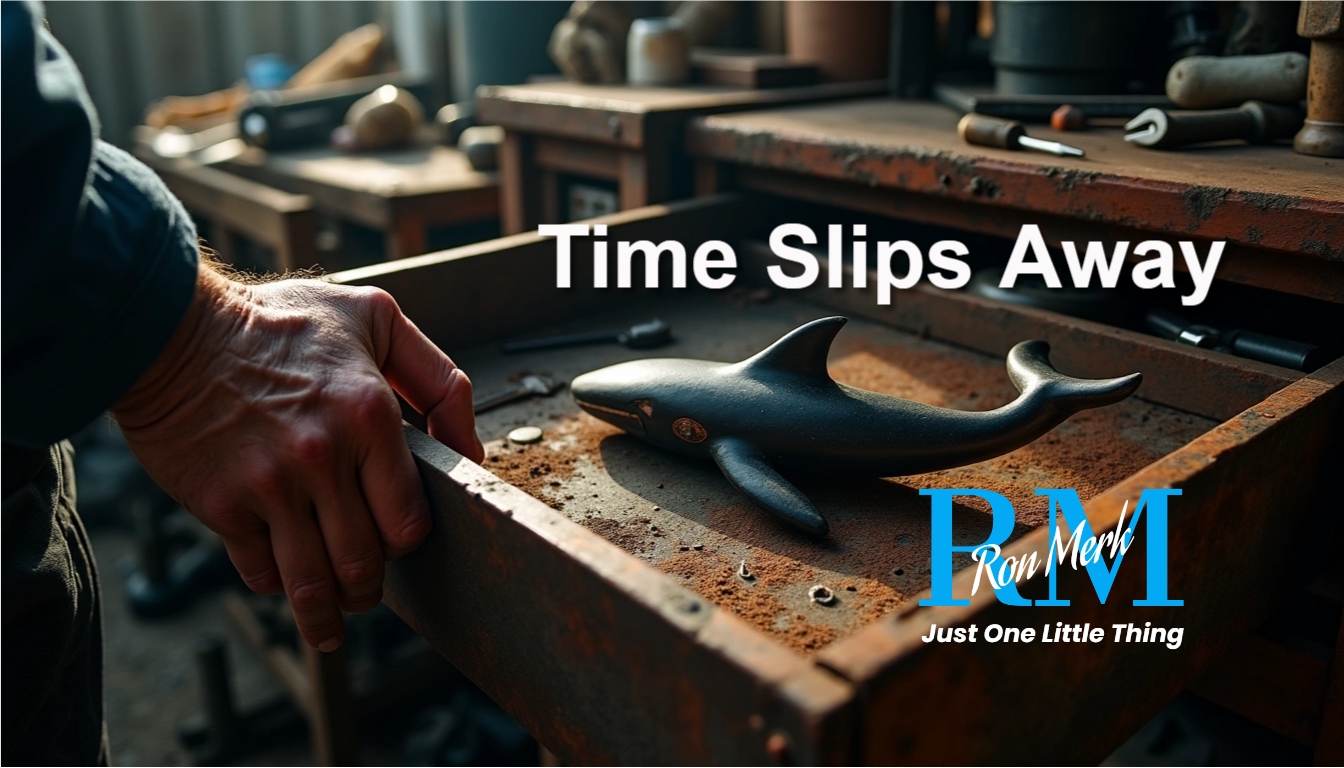
For fifty-two years, Arthur was known as the good guy in town. The quiet millwright who fixed broken tools for free. But harmlessness isn’t the same thing as goodness.
Now, with six months left to live, he has to confront the old Nabob coffee can hidden behind the blueprints in his backyard tool shed. Inside is a sacred Nuu-chah-nulth speaker’s staff top, kicked into the mud during a vicious racial eviction at a 1974 saw mill. Arthur didn’t cause the violence that night; he just stood by and kept the evidence.
Time is slipping away. As Arthur loads his truck for a final, desperate drive to the outer coast to return it, he is about to face a modern reality: in 2026, the descendants of the man he failed aren’t interested in providing his redemption.
Part 1: The Tool Shed Verdict
The damp chill of an Alberni June doesn’t rise from the ground; it drops from the sky like a wet wool blanket, settling into the joints of old men and old machinery alike.
Arthur held his breath against the familiar smell of his backyard workshop. The sharp, vinegary bite of 3-in-One oil, the sweet scent of damp cedar shavings, and the heavy grease of ancient iron. For forty years, this twelve-by-sixteen shed had been his sanctuary. When the MacMillan Bloedel lumber mill cut him loose with a pension and a gold-plated watch that lost three minutes a day, he had moved his life out here. He fixed things. That was his reputation in town. If a neighbour’s lawnmower sputtered, if a widow’s kitchen drawer jammed, or if some young kid bought a vintage chainsaw he didn’t know how to tune, they brought it to Arthur.
He never charged a dime. He’d just nod, slide a greasy rag across his workbench, and say, “Leave it with me.”
He liked the quiet utility of it. He liked being known as the good guy on the block. The gentle, reliable old millwright who could restore order to things that had lost their way. It was a comfortable suit of clothes to wear in the twilight of life. It was the ultimate insulation against the world.
But three weeks ago, a young doctor at West Coast General Hospital had sat him down, looked at a gray-and-white shadow on a computer screen, and effectively turned the hourglass upside down. The sand wasn’t trickling anymore; it was dumping. Arthur had maybe six months before the cancer in his lungs stopped him from drawing a clean breath. Suddenly, the quiet safety of the shed felt less like a sanctuary and more like a holding cell.
Arthur’s hands, usually as steady as a vice-grip, shook slightly as he reached past a row of organized glass jars filled with sorted nuts, bolts and Robertson screws. He didn’t reach for a tool. Instead, he slipped his fingers behind a stack of dusty, pre-war blueprints for mechanical equipment he’d worked on in the mills and pulled out a rectangular tin box. It was an old Nabob coffee can, its red paint faded to the colour of dried blood.
He brought it down to the grease-stained plywood of his workbench, under the harsh glare of a single fluorescent tube. He didn’t need to open it to know what was inside, but his failing body demanded proof. He pried the plastic lid off.
Inside, wrapped in an oily yellow rag that had once been a flannel shirt, was a piece of dark Nootka cypress. It was barely eight inches long, carved with an economy of line that only a master could manage. It was the top of a Nuu-chah-nulth speaker’s staff. A stylized killer whale emerging from a crest of stylized waves, its dorsal fin high and sharp, its blowhole a deeply recessed cavity that seemed to swallow the light. Even under the layer of dust and five decades of workshop grime, the wood possessed a deep, inner red hue, like wood that had grown up in the deep shadow of the old-growth forest before the iron came.
Arthur didn’t touch the wood. He just looked at it, the weight of fifty-two years of silence pressing down on his chest, heavier than the tumour.
The memory didn’t slip away; it waited for him, completely preserved in the amber of his own cowardice.
It was the afternoon shift, October 1974. The rain was coming down in sheets off the Alberni Inlet, turning the gravel yard of the Timber Ltd Lumber Mill into a soup of gray mud and diesel fuel. Arthur was twenty-four then, a junior millwright with a young wife at home and a desperate need to keep his nose clean and his union dues paid.
The lunch room was loud, thick with the smell of sweat and wet wool, and the aggressive, territorial heat of forty men who spent ten hours a day dodging falling lumber. Near the heavy oil stove at the back sat Thomas. Everyone knew Thomas, though nobody in the crew called him by his traditional name. He was a Nuu-chah-nulth man from one of the villages down the canal, a quiet, green-chain worker who always pulled more than his share of wood on the chain.
Thomas had brought the carved staff-piece into the lunchroom that night. He was rubbing it with cedar oil, his thumb smoothing the grain of the killer whale’s fin. He was proud of it. He had told Arthur earlier that day, in a rare moment of conversation over a shared thermos of tea, that it was for his house group. A piece meant to be carried by the man who spoke for his family’s lineage at the upcoming potlatch, a practice that had only been legal again in Canada for a couple of decades.
Then the door swung open, and three shingle sawyers walked in. They were drunk on smuggled rye, their boots tracking thick, red clay across the linoleum. They were looking for something to break.
Arthur had been sitting by the heater, a hot coffee cup warmed his hands. He saw the shift in the room before it happened. He saw the way the largest of the sawyers, a brute named Henderson who carried a permanent chip on his shoulder from a bad marriage and a lifetime of poor choices, locked eyes on Thomas.
“What’s a Siwash doing with church property in here?” Henderson barked, his voice cutting through the clatter of heavy ceramic mugs.
Thomas didn’t look up. He kept his thumb moving over the cedar whale, but his shoulders went rigid. “It’s not church property,” Thomas said softly. “It’s my grandfather’s.”
“It’s stolen junk,” Henderson said, stepping closer. The two other sawyers closed in behind him, a wall of plaid and wet leather. “And I don’t like looking at it while I eat.”
What followed wasn’t a fight; it was an eviction. It was a coordinated, casual act of violence that happened all the time in the valley back then. The kind of cruelty that was built into the very foundations of the timber towns, as accepted as the smoke from the beehive burners. Henderson grabbed Thomas by the collar of his Mackinaw. Thomas stood up, trying to shield the carving, but the other two riggers slammed him against the long wooden table, scattering lunch kits and spilling hot coffee.
Arthur watched it all. He didn’t move. He didn’t yell for the shift boss. He didn’t even drop his coffee cup. He just stood by the heater, his heart hammering against his ribs, his mind spinning a web of immediate, self-preserving justifications: I have a baby on the way. Henderson could break my jaw. It’s none of my business. It’s just how things are here.
They dragged Thomas out into the dark, into the pouring rain. Arthur heard the wet thud of boots hitting flesh in the gravel yard, the slurred curses of the sawyers, and then the sound of Thomas’s old Chevy truck roaring to life, its tires spinning wildly in the mud as he fled into the night, leaving his job and his dignity behind.
When the lunchroom settled back into its sullen, quiet rhythm, the sawyers walked back in, laughing, wiping mud from their knuckles. Nobody said a word to them. Arthur, ashamed to his very bones, walked toward the door to leave.
Stepping outside, he saw movement to his right. I quick glance and he recognized the shift supervisor standing in the shadows. That’s when he realized the sawyers were acting under orders. This was more than three race haters. This was the system, doing what all systems do.
Arthur hung his head as he contemplated the injustice of it. That was when he saw it. In the scramble near the door, the carved whale had been kicked under a storage wood box. Its base was splintered where a heavy work boot had stepped on it, but the whale itself was intact.
Arthur slipped the piece of cedar into his canvas lunchbox, closed the lid, and walked to his job site. He told himself he would find Thomas the next week and give it back. But Thomas never came back to the Timber Ltd Mill. As the months turned into years, and the years into decades, the carving stayed in Arthur’s toolbox, then his drawer, and finally behind the blueprints in his shed.
He had convinced himself that keeping it safe was an act of preservation. He had told himself that if Henderson or the others had found it, they would have smashed it to pieces. By keeping it hidden, he was the protector of the artifact.
“You old fool,” Arthur whispered into the empty shed, his voice cracking.
The fluorescent light hummed above him. It was 2026. The world had changed outside his shed. On the radio, they talked about reconciliation, about truth, about the UN Declaration on the Rights of Indigenous Peoples. Governments made grand speeches in Victoria and Ottawa. But here in his hands was the real truth: fifty-two years of a stolen heritage, locked in a Nabob coffee tin while the man who carved it had faded into a ghost.
Arthur had used a local library computer a week ago to look into the records from the seventies. Thomas was gone; he had died in a rooming house on East Hastings in Vancouver back in the nineties, a man broken by the displacements of the coast. But his family, his descendants, were still active in the house groups in his home village on the outer reaches of the West Coast of Vancouver Island.
Arthur reached down and lifted the cedar whale from the tin. His thumb found the exact spot Thomas’s thumb had been fifty-two years ago. The wood felt cold.
He didn’t have much time left. The doctor had been clear about that. But he had enough time to drive. He had enough gas in his old F-150, and he had the one thing he had denied Thomas’s family for half a century.
He wrapped the carving back in the yellow flannel, placed it gently into a clean canvas tote bag, and picked up his truck keys from the workbench. He didn’t lock the shed door as he left. For the first time in his life, he didn’t care about protecting his tools. He cared about the verdict that was waiting for him at the end of the road.
Part 2: The Highway to Redemption?
You Can’t Drive Fast Enough to Outrun a Fifty-Year Silence.
The highway heading west out of Port Alberni doesn’t invite reflection; it demands survival. For an old man with fluid pooling in his lower lobes, the stretch of tarmac twisting west toward the open Pacific is a physical trial. Arthur gripped the worn vinyl of the F-150’s steering wheel, his forearms aching from the constant correction required to keep the ancient truck centred between the rock faces of the pass and the dizzying drops below.
Every mile driven was a subtraction. The thick, second-growth firs gave way to the jagged, wind-scoured giants of the outer coast. The air coming through the dashboard vents changed, losing the sweet, dusty smell of the inland valley and taking on the salt-heavy, decaying tang of the open ocean.
On the seat beside him, the canvas tote bag sat like a passenger who refused to speak.
Arthur coughed. A deep, rattling sound that started in his boots and ended with the taste of copper in the back of his throat. He reached for a plastic bottle of water, took a shallow sip, and watched the windshield wipers smear a greasy film of coastal fog across the glass. He was seventy-six years old, and until this morning, he had believed that driving three hours to hand over a piece of wood would feel like a release. He had imagined a quiet, dignified exchange. Perhaps a cup of tea in a warm kitchen, a shared nod of understanding between two people who recognized that the past was a heavy country.
He was an old man dying of a modern disease; surely that bought him some grace.
But as the truck rumbled past the junction and headed north toward the remote Nuu-chah-nulth communities along the outer west coast, the romantic illusion of his mission began to peel away like wet bark. The road wasn’t a bridge between eras; it was a line drawn through an ongoing wound.
By the time Arthur pulled into the gravel lot of the tribal administration building, the afternoon light had flattened into a bruised, metallic gray. The building was a modern structure, sharp cedar beams and large glass windows that looked out over an inlet where fish-boats bobbed against a floating dock. It was a bustling place, completely indifferent to his arrival. Young people in high-visibility vests carrying salmon-fishing gear argued over clipboard data near the door; a woman with a child on her hip pushed past him, her boots clicking sharply on the concrete walkway.
Arthur stood in the lobby, holding the canvas bag against his ribs like a shield. He felt distinctly out of place. An old, gray-haired white man from the mill town, wearing a stained Carhartt jacket and smelling of wood smoke, iron and old grease.
“Can I help you with something?”
The voice belonged to a woman behind the main counter. She was in her late twenties, her dark hair pulled back in a sharp, professional braid. She wore a black sweater with a stylized raven design embroidered on the sleeve. Her desk was a battlefield of spreadsheets, funding applications, and a laptop displaying a 2026 calendar packed with language revitalization meetings.
“I’m looking for the family of Thomas,” Arthur said, his voice coming out thinner than he intended. He used the English surname he had found in the old log camp ledgers. “Thomas ... from the Timber Ltd Lumber Mill crew back in seventy-four.”
The woman stopped typing. Her eyes, cool and analytical, travelled from Arthur’s face down to the canvas bag, then back up. “Thomas was my great-uncle,” she said. Her tone wasn’t hostile; it was simply flat, stripped of the polite deference Arthur was used to receiving from service clerks in town. “He passed away in ninety-two. Who are you?”
“My name is Arthur. I was a millwright at the mill.” He swallowed, his throat dry. “I have something that belonged to him. Something he... he left behind the night he left the valley.”
The woman, whose desk nameplate read Winona, didn’t reach for the bag. She leaned back in her chair, her arms crossing over the raven emblem on her sleeve. The silence between them grew heavy and dense, punctuated only by the distant hum of a printer in the back office.
“Left behind,” she repeated. It wasn’t a question. It was a statement that carried a distinct edge of historical irony. “That’s one way to put it. The story we have in our family is that he was beaten by three white sawyers while forty others watched, and then his truck was shot at while he drove out of the gate.”
Arthur felt the blood drain from his face. The single fluorescent tube above her desk seemed to intensify, casting hard shadows under his eyes. “I didn’t watch that part,” he whispered. “I was inside. By the oil heater.”
“But you were there.”
“Yes.”
Winona looked at him for a long time. She didn’t look angry in the way Arthur had feared. There were no raised voices, no dramatic accusations. Instead, her expression was one of profound, bone-deep exhaustion. It was the look of someone who had spent her entire young life explaining the obvious to people who had the luxury of forgetting.
“Come with me,” she said, standing up.
She led him out the back of the building, down a gravel path that wound toward a cluster of older cedar homes built near the high-tide line. The sea was coming in, the dark green water churning over black rocks, leaving a fringe of white foam on the hemlock roots.
They stopped outside a small, weathered workshop that looked remarkably like Arthur’s own, though the smell here was different. Less grease, more raw cedar and the sharp, marine scent of dried kelp. Sitting on a low bench outside the door was an older man, his face lined by decades of salt air, his hands busy with a small sharpening stone and a curved detail knife.
“Dad,” Winona said, speaking in a tone that was suddenly softer, though her eyes remained fixed on Arthur. “This is Arthur. He drove up from Alberni. He says he was at the Timber Ltd Mill the night Uncle Thomas was run out.”
The carver stopped his stone. He didn’t look up immediately. He wiped the blade of his knife on his denim pants, his movements slow and deliberate. When he finally raised his head, his eyes were the colour of the winter sea. Pale, clear, and entirely unimpressed by Arthur’s presence.
“An Arthur from the mill,” the older man said, his voice deep and gravelly. “Fifty years late for a shift, aren’t you?”
Arthur didn’t answer. He couldn’t. He reached into the canvas bag with trembling fingers and pulled out the yellow flannel rag. He unwrapped it slowly, revealing the dark cypress killer whale. The dorsal fin caught the gray coastal light, the deeply carved lines of the blowhole looking like an open mouth waiting for a word that had been held back for half a century.
The carver didn’t move. He didn’t gasp. He didn’t reach out to grab the treasure that had been missing from his family’s lineage for two generations. He just looked at it, his face setting into a hard, unyielding line that made Arthur feel smaller than the dust on his own workshop floor.
“You’ve had that in your house since nineteen-seventy-four?” Winona asked. Her voice had lost its flat administrative tone; it was dangerous now, humming with the live-wire tension of 2026.
“I kept it safe,” Arthur said, the words tasting like ash in his mouth. He realized, with a sudden, terrifying clarity, how pathetic the defence sounded. “I thought... if the sawyers found it, they would destroy it. I put it in my lunchbox. I kept it behind my blueprints in my workshop.”
Winona stepped closer, her shadow falling over Arthur. “You didn’t keep it safe,” she said, her words hitting him like physical blows. “You hid it. You held onto it while my grandfather had to stand at the nineteen-seventy-eight potlatch with a borrowed stick because his family’s speaker’s crest was sitting in a white man’s tool shed. Do you have any idea what it took for us to survive without our things? You think you’re doing us a favour by bringing it back now because you’re old?”
Arthur stood there in the damp coastal drizzle, the cedar whale heavy in his hands, realizing that the road to returning the head of this family’s talking stick wasn’t a path to redemption. It was a witness stand.
Part 3: The Price of the Return
Reconciliation is a White Man’s Word for an Unpaid Debt.
The wind off the sound didn’t care about Arthur’s lungs. It drove the cold rain straight through his Carhartt jacket, pinning his damp shirt to his ribs. He stood there, extending the yellow flannel rag like a beggar offering a broken coin.
The carver, whose name Arthur now knew was Robert, didn’t stand up from his bench. He reached out with one broad, calloused hand. A hand that had spent a lifetime holding the grain of the West Coast, and took the cedar whale by its high dorsal fin. He didn’t handle it with the fragile reverence of a museum curator. He held it hard, his thumb immediately finding the splintered base where Henderson’s boot had gouged the wood fifty-two years ago.
Robert looked at the fracture, then looked up at Arthur. “My brother spent three weeks carving this,” Robert said, his voice as steady as the tide. “He missed two weeks of the fall run because his hands were too cramped to haul nets. He did it because our uncle was dying, and someone needed the right to speak for the house group when the copper was broken. When Thomas came back without it, he didn’t tell us he lost it. He told us they broke it.”
“They didn’t break the whale,” Arthur said desperately. “It fell under a box during the scuffle. I... I saved the whale.”
“You kept a secret,” Winona interrupted, her voice cutting through the sound of the surf. She stepped between Arthur and the workshop bench, forcing the old millwright to look at her. “Let’s be honest, Arthur. Every week, someone like you shows up on our coast. A retired teacher with a box of skulls that their grandfather dug up from a burial cave. A lawyer with a ceremonial blanket draped over their pool table. You all want the same thing. You want us to look at you, tell you you’re one of the good ones, and give you a clean slate before you go to the hospital.”
The truth of her words didn’t sting; it crushed. Arthur felt the smallness of his life. The forty years of being the neighbour who fixed lawnmowers for free, the quiet citizen who never caused trouble, evaporate into the gray fog. He had spent his whole life avoiding conflict, believing that neutrality was a virtue. He had thought that by not being Henderson, he was innocent.
“I don’t want a clean slate,” Arthur whispered, a sudden fit of coughing racking his chest. He doubled over, his hand catching the edge of the wooden box to keep from falling. When he straightened, wiping his mouth with a trembling sleeve, his eyes were red. “I’m dying. I know what I did. I was a coward in that lunchroom. I’ve been a coward every day since. I don’t want you to tell me I’m good. I just wanted the whale to be where it belongs before the sun goes down on me.”
Robert looked from the carving to Arthur’s gray, sweating face. The old carver stood up then, his joints popping with the same heavy groan Arthur knew from his own body. He didn’t offer Arthur a hand, but the hard, defensive edge in his eyes softened into something more dangerous: pity.
“You think your death is the end of the story, Arthur?” Robert asked softly. “It’s not. This piece has to go into the Big House. It has to be washed. We have to tell the family why it’s been gone for fifty years, and we have to name the man who had it behind his blueprints. Your name is going into our history now. Not as a hero. As the man who kept the whale in the dark.”
Arthur nodded. The weight of that judgment was immense, but for the first time since the doctor had shown him the X-ray, the tightness in his chest wasn’t just the tumour. It was reality. He had spent fifty years trying to remain unwritten in the history of this coast. Now, his silence was being recorded.
“That’s fair,” Arthur said.
Winona watched him, her arms still crossed over her chest, but the anger in her expression had settled into a quiet watchfulness. “The road back to the valley is going to be washed out at the summit if you don’t leave before dark,” she said, her voice returning to that flat, professional cadence. “There’s no hotel here for you.”
“I’m leaving,” Arthur said.
He looked at the cedar whale one last time. In Robert’s hands, against the backdrop of the raw cedar shavings and the gray sea, the dark Nootka cypress didn’t look like an old relic from a gravel yard of an old lumber mill anymore. It looked alive. It looked like it had never belonged to Arthur for a single second of those fifty-two years. He had just been the box it was trapped in.
The drive back down the highway was done in total darkness. The rain had turned into a torrential downpour, the logging trucks roaring past the F-150 in the opposite direction, blinding Arthur with their high beams and throwing sheets of black water across his windshield.
His truck felt lighter. The passenger seat was empty; the canvas tote bag lay crumpled on the floorboards. But his chest felt hollowed out, like an old log that had been cleaned out by ants.
He didn’t turn on the radio. He didn’t want to hear the news of 2026, the speeches about reconciliation, or the talk about things being made right. He knew now that nothing was ever truly made right; the fifties, the seventies, the nineties. They were all piled on top of each other, an unyielding layer of sediment that couldn’t be washed away by a single long drive. Thomas had still died alone on East Hastings. The family had still stood at the potlatch with a borrowed stick. Arthur’s lifetime of kindness hadn’t saved a single thing.
When he finally pulled into his driveway in Port Alberni, the clock on his dashboard read 10:03 PM. The house was dark.
Arthur didn’t go inside. He walked down the gravel path to the backyard, his boots squelching in the mud, and pushed open the door to his workshop. He didn’t turn on the fluorescent light. He sat down on his wooden stool in the dark, surrounded by the smell of 3-in-One oil and sorted screws.
He looked at the empty space behind the pre-war blueprints where the Nabob tin had sat for decades. The void was small. Barely eight inches wide, but it felt like a hole through the side of the world.
Arthur leaned his head back against the cedar wall of the shed and closed his eyes. The clock on his workbench ticked, a steady, mechanical countdown against the damp silence of the valley. Time was slipping away, but as he sat there in the dark, Arthur realized he was finally matching its pace. He had delivered the verdict to himself, and for the first time in seventy-six years, he wasn’t asking for the sentence to be commuted.
Disclaimer: This story is a work of fiction. While it is set against the backdrop of real historical eras and locations on the West Coast of BC, Canada, all characters, organizations, and incidents depicted are entirely the products of the author’s imagination. Any resemblance to actual persons, living or dead, or actual events is purely coincidental.