
Free Stuff, Please Inspect Carefully
Sidewalk Chaos, Human Curiosity, and Critically Judging Raccoons

When Free Meets Suspicion
In Port Alberni, there are certain things people will help you with immediately, no questions asked. Moving a couch is one of them. You can stand in your driveway looking slightly discouraged beside a couch, and within minutes, someone will slow their truck, roll down the window, and ask where it’s going. But there’s another kind of couch situation in town that does not attract nearly the same level of enthusiasm, and that is when the couch is sitting on the curb with a cardboard sign that says FREE. In bigger places, a sign like that works like a magic spell. When I lived for a while in Victoria, people would set something on the sidewalk, and it would disappear faster than a donut at a morning council meeting. Lamps vanished, chairs vanished, and I’m fairly sure someone once put out a canoe paddle and watched it disappear before they got back inside. But Port Alberni is not a city that rushes into decisions like that. Around here, a Free Pile is not something people grab. It’s something people study.
The first time I really noticed this was last spring when my neighbour Carl wheeled a treadmill out to the edge of the sidewalk. Carl had purchased the treadmill with the sort of hopeful determination that usually lasts about three weeks. He had announced to everyone at the coffee shop that he was going to start walking every morning, rain or shine. By the fourth week, the treadmill had become something else entirely, which is to say it had become a very effective place to hang jackets, towels, and the occasional pair of jeans that weren’t quite ready for the laundry. Carl later told me that when he mentioned buying a treadmill to his doctor, the doctor had nodded and said, very seriously, that treadmills make excellent clothes hangers. Carl already owned several perfectly good clothes hangers, so the treadmill rolled out to the curb with a handwritten sign that said FREE – WORKS GREAT, which is exactly the kind of statement that makes people in this town deeply suspicious.
The treadmill sat there for most of the first day without anyone touching it. People slowed their vehicles when they drove past, the way people slow down when they see an unfamiliar animal near the road. A couple walking their dog stopped and examined it from several angles, but they kept their hands in their pockets as if the machine might suddenly demand a commitment. The second day, a man from two houses down stepped onto Carl’s lawn, leaned over the treadmill, and pushed the belt with one finger just to see if it moved. When it did move, he nodded thoughtfully, the way a mechanic nods at an engine that has started but might not keep running, and then he walked away. By the third day, it had become clear that the treadmill was not going anywhere quickly. It had entered what I would later come to think of as the Port Alberni Free Pile Evaluation Period, which can last anywhere from several days to what some people refer to as indefinitely.
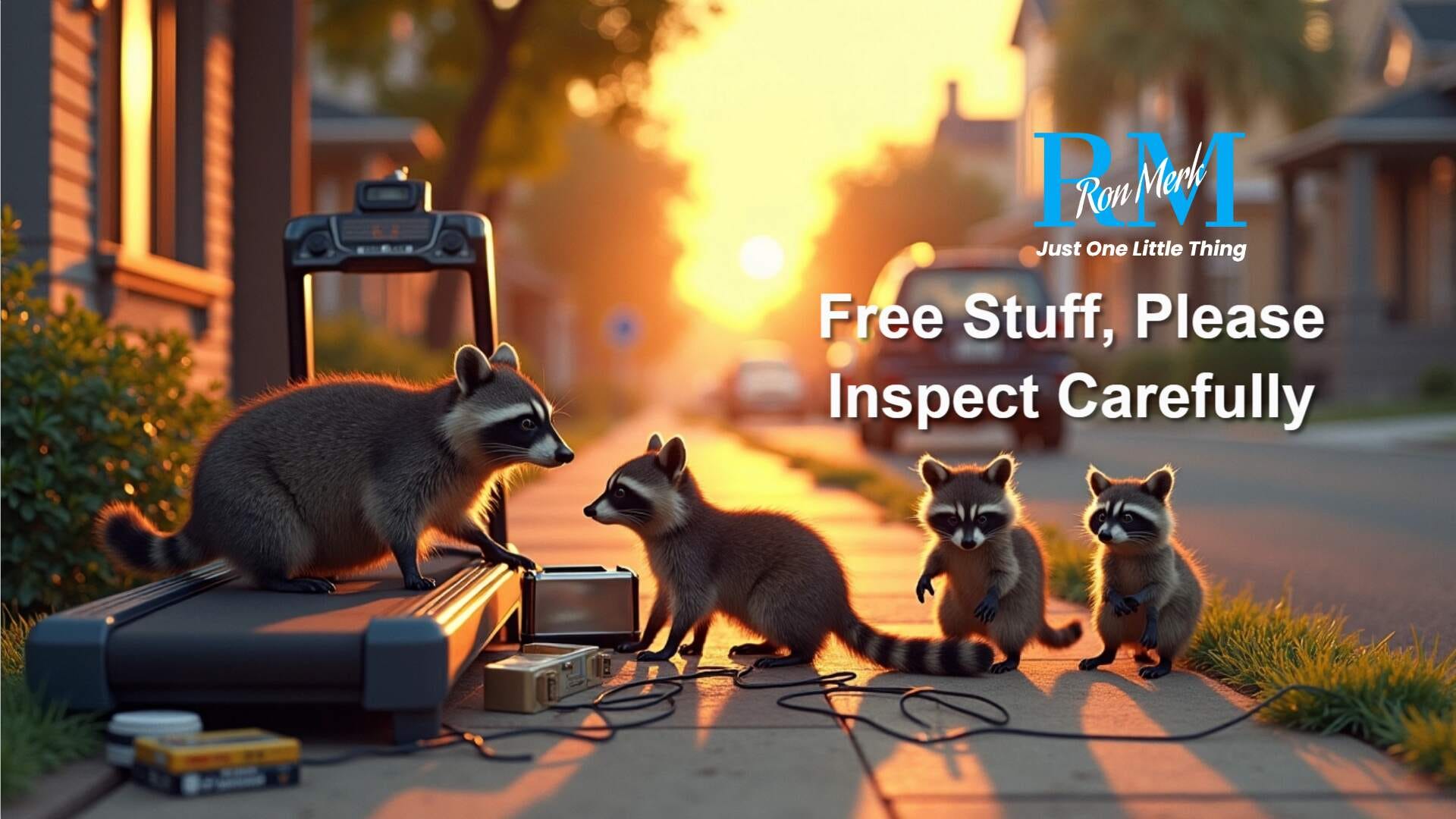
That’s when the raccoons arrived. Now the raccoons in our neighbourhood are not the kind that rush into situations. They move with the same quiet patience that you see in people examining a clearance rack. The first one appeared just after sunset, climbing carefully onto the treadmill as though he had been sent ahead to check the engineering. Behind him came three smaller raccoons that I assumed were his children, though it was possible they were simply apprentices. They sniffed the handles, the control panel, and the rubber belt, clearly taking the whole matter very seriously. One of the younger raccoons stepped onto the belt and walked forward, which caused the treadmill to roll slightly and squeak. The raccoon froze for a moment, looked down at the machine, and then stepped off with the quiet dignity of someone who had discovered that exercise equipment might be unnecessary in his life. After a few minutes of inspection, the raccoons climbed down and wandered away into the bushes, leaving the treadmill exactly where it was.
What none of us realized at the time was that Carl’s treadmill was about to become something much bigger than a discarded piece of exercise equipment. In Port Alberni, a single free item on the sidewalk has a strange gravitational pull. It attracts attention, curiosity, and eventually other items that people were never quite sure what to do with in the first place. By the end of that week, the treadmill would no longer be sitting alone. It would be the first object in what would soon become the most carefully examined and least successful Free Pile our street had ever seen. And every evening, just as the light started fading, the raccoons would return to inspect it again, as if they had been appointed the official quality control department for the entire operation.
The Parade of Oddities
In a place like Port Alberni, a single free item on the sidewalk rarely stays alone for long. It’s a little like leaving one potato chip on a plate at a party. At first, everyone pretends not to see it. Then someone decides it would be a shame to waste the opportunity. Carl’s treadmill sat quietly beside the curb for nearly three full days before the first companion item appeared. No one ever admitted responsibility, but one morning, a cardboard box had materialized beside the treadmill. On the side of the box, someone had written, in careful marker, “VHS TAPES.” This was followed by a smaller note underneath that said, “Still Good Movies.” That second sentence told you a lot about the optimism of the person who left them there.
The VHS tapes sat beside the treadmill like two retirees keeping each other company. People walking their dogs slowed down to examine the titles, which included several action movies from the 1990s and a documentary about whales that had clearly been watched many times. No one took a single tape, which may have had something to do with the fact that VHS players have quietly disappeared from most living rooms. But the presence of the box had an effect. By the following afternoon, someone had added a standing lamp that looked as though it had once been fashionable during a period when people believed brass could solve most decorating problems.
Carl stood on his porch and observed these developments with the calm satisfaction of a man whose experiment was working exactly as expected. “You see,” he said to me one morning, gesturing toward the sidewalk like a museum curator unveiling a new exhibit, “the pile is growing.” He spoke about it the way farmers talk about crops. The treadmill had become the center of something that was beginning to resemble a small outdoor marketplace, except nothing was actually leaving.
The raccoons, however, had not lost interest. Each evening, just after the sun disappeared behind the trees, the family returned to conduct their inspection. The large raccoon, who seemed to be the one in charge, approached the pile slowly and examined each object with the careful attention of someone evaluating real estate. The younger raccoons moved more quickly, climbing over the box of tapes and sniffing the base of the lamp. One of them tried to peer inside the toaster that appeared two days later, which suggested that the raccoon was either very curious or quietly hopeful that the machine might contain bread.
The toaster, incidentally, had been contributed by Mr. Jensen, who lived three houses down. Mr. Jensen had stopped his truck one afternoon, stepped out, and spent several minutes studying the treadmill the way a mechanic studies a piece of machinery he doesn’t entirely trust. After a long moment, he nodded thoughtfully and said, “You know what this pile needs?” Carl asked what that might be. “A better toaster,” Mr. Jensen replied. Two mornings later, the toaster appeared. It was placed carefully on top of the VHS tapes as if it were the crown jewel of the entire collection.
What fascinated me most about the situation was not the pile itself but the way people interacted with it. Nobody seemed willing to take anything home, but everyone felt perfectly comfortable adding something to the collection. Over the next week, the pile developed the slow, steady growth of a coral reef. A folding lawn chair appeared one morning, followed by a bread maker that looked like it had been used exactly once before its owner remembered they preferred buying bread from the grocery store. Someone contributed a cardboard box filled with electrical cords that no one could identify, but no one felt comfortable throwing away either. The box was labelled “Probably Useful,” which is the highest level of confidence most people feel about mysterious cords.
The raccoons continued their nightly evaluations, and they appeared to have developed strong opinions about the quality of the merchandise. They ignored the VHS tapes entirely, which made sense since raccoons rarely watch documentaries about whales. They showed mild interest in the bread maker, possibly because it smelled faintly like flour. But the object that fascinated them most was still the treadmill. Every few evenings, one of the younger raccoons would climb onto the belt and take a few careful steps, which caused the machine to squeak and roll slightly. Each time this happened, the raccoon would pause and stare at the machine as if reconsidering several life choices.
Meanwhile, the reputation of the pile began to spread beyond our street. People driving through the neighbourhood slowed their cars to take a closer look, and a few visitors even stepped out to examine the items like tourists at a roadside attraction. One couple stopped and studied the treadmill for nearly five minutes before the man finally shook his head and said, “In the city this would’ve been gone in ten minutes.” His wife nodded in agreement and then climbed back into the car without touching anything.
Carl watched all of this with the quiet pride of someone who had accidentally created a public service. What he had originally intended as a simple giveaway had become something much larger. It had become a kind of community project, a place where the town’s most questionable household items gathered together for a second chance that never quite arrived. Every evening, as the daylight faded and the street grew quiet, the raccoons returned once again to inspect the merchandise, as if they were the only creatures in Port Alberni seriously considering whether any of it was actually worth taking home.
The Legend of the Persistent Free Pile
By the third week, the Free Pile on Carl’s sidewalk had achieved something remarkable. It had become a stable fixture in the neighbourhood, neither shrinking nor growing in any significant way, yet never quite going away. The treadmill remained, the toaster perched proudly atop a small mound of VHS tapes, the bread maker stood like a sentry, and the box of “Probably Useful” cords leaned politely against the curb, quietly mocking anyone who dared question its purpose. New additions still appeared. Someone left a plastic Christmas wreath, a chipped teapot, and even a small stuffed dinosaur that had probably belonged to a child who had long since moved on, but the pile no longer sparked the flurry of activity one might expect from free items in a big city. In Port Alberni, the Free Pile had become more of a philosophical statement than a practical one, a kind of slow-motion social experiment that nobody asked for but everyone watched with a mix of curiosity and quiet amusement.
The father raccoon gave each object a deliberate once‑over, as if judging whether it belonged in some exclusive club. The children climbed on and around the items, sniffing, testing, occasionally tugging gently on the cords or nudging the bread maker to see if it would offer a treat. They seemed to understand the rules better than the humans did: no item could be removed, but every item could be judged, inspected, and debated endlessly. Occasionally, one raccoon would pick up something small. A sock, a spoon, a piece of string, and carry it off into the bushes, leaving the humans guessing which item had passed or failed the critter’s rigorous assessment. Even the treadmill, the original star of the pile, continued to elicit cautious steps from the youngest raccoon before being abandoned for something apparently more interesting, like a cardboard box with faintly mysterious contents.
The neighbourhood began to treat the Free Pile with the reverence of a minor landmark. People walking their dogs slowed down, sometimes pausing to discuss the latest additions. Visitors from outside the area would stop to take photographs, unsure whether to admire the collection or lament the apparent lack of value in any of it. Carl stood on his porch most mornings, sipping coffee and watching the parade of observers with a satisfied smile. To him, this was more than a pile of unwanted items; it was a living, breathing monument to community spirit and small-town patience. “You see,” he said one day to a passing neighbour, “the pile teaches people to slow down. It teaches them to observe. It teaches them that not everything must be rushed.” The neighbour nodded thoughtfully, though whether he truly understood the depth of Carl’s statement was impossible to tell.
And so the pile remained. Weeks passed, then months, and by summer it had achieved a quiet fame. The local newspaper sent a photographer to capture the pile for a feature, the headline reading something like: “Port Alberni’s Persistent Free Pile: Where Items Wait and Raccoons Reign.” Carl framed the article and proudly displayed it in his living room. The treadmill was still there. The toaster was still there. True to form, the raccoons continued their evening rounds with the same careful scrutiny they had shown from the very beginning. Port Alberni had discovered a kind of fame that no other city could quite replicate. Not for the quality of what was given away, but for the patience, the endurance, and the quietly humorous spectacle of things nobody really wanted.
Then, of course, the city bureaucracy noticed. It started with a polite letter slid under Carl’s door, printed in the kind of font that says, “We are serious, and we also have clip art of a gavel.” The letter explained that while the town appreciated community initiatives, a “free pile of indefinite duration” technically fell under several sections of the local bylaws, none of which anyone ever really read until now. Carl thought about ignoring it, but the next morning, there was a knock at the door that sounded like a small parade of seriousness.
Standing there was Mr. Higgs, the bylaw officer, looking as if he’d been trained in the art of discouraging joy. He carried a clipboard, a laser-like stare, and an aura that suggested he once made a child remove a snowball from public property. “Good morning,” he said cheerfully. “I’m here about the pile.” Carl smiled. “You mean our local celebrity?” Higgs did not smile. “It’s a violation,” he said. “Items must be removed within seventy-two hours.” Carl looked down at the treadmill, then at the toaster, then at the box of cords labelled Probably Useful. “Seventy-two hours?” he asked. “That’s… very specific.” “Bylaw officers are nothing if not specific,” Higgs replied.
Meanwhile, outside the window, the raccoons sensed the firm foot of bureaucracy and were in full panic mode. They darted between the treadmill and the box of cords, hissing indignantly and waving their little paws like tiny union organizers. Carl tried to calm them. “It’s okay,” he said, “we’ll find a solution.” But the raccoons were unconvinced. They could sense that the free pile’s glory days were about to be numbered, and they didn’t appreciate it. One of the younger raccoons even attempted to climb Higgs’s leg, as if to negotiate a better deal. Higgs stepped back quickly, taking meticulous notes on his clipboard, and muttered something about “wildlife interference” under his breath.
Carl spent the next hour dismantling the pile with as much grace as possible, though grace was hard to maintain while carrying a treadmill through the front yard and politely explaining to every neighbour why this historic sidewalk landmark was disappearing. Each item had its own farewell ceremony, complete with raccoon-approved inspections. The treadmill got the most attention, with the father raccoon circling it three times before squatting and giving it a solemn, judgmental sniff. The toaster was given a miniature salute. Even the box of cords received a respectful nod.
By mid-afternoon, everything was gone. The sidewalk looked empty, sterile, almost suspiciously neat. The raccoons sat on the curb, staring at the now barren concrete like philosophers contemplating the fleeting nature of life, and possibly plotting their revenge. Carl leaned against the front porch post and sighed, trying to imagine a world in which free piles could persist forever. Higgs scribbled a final note on his clipboard, nodded at Carl, and drove off, unaware that he had just become the antagonist in a small-town legend.
That is how the street returned to normal, at least in theory. But Carl knew better. Every time he glanced at the empty patch of sidewalk, he imagined the treadmill quietly sighing, the toaster waving farewell, and the raccoons gathering in secret meetings to plan the next dramatic pile. For in Port Alberni, even when the city insists on order, a Free Pile leaves its mark, and the raccoons never forget.