
76 & Fighting It
A Birthday Story of Avoidance, Aching Knees, and One Man’s Losing War Against the Calendar

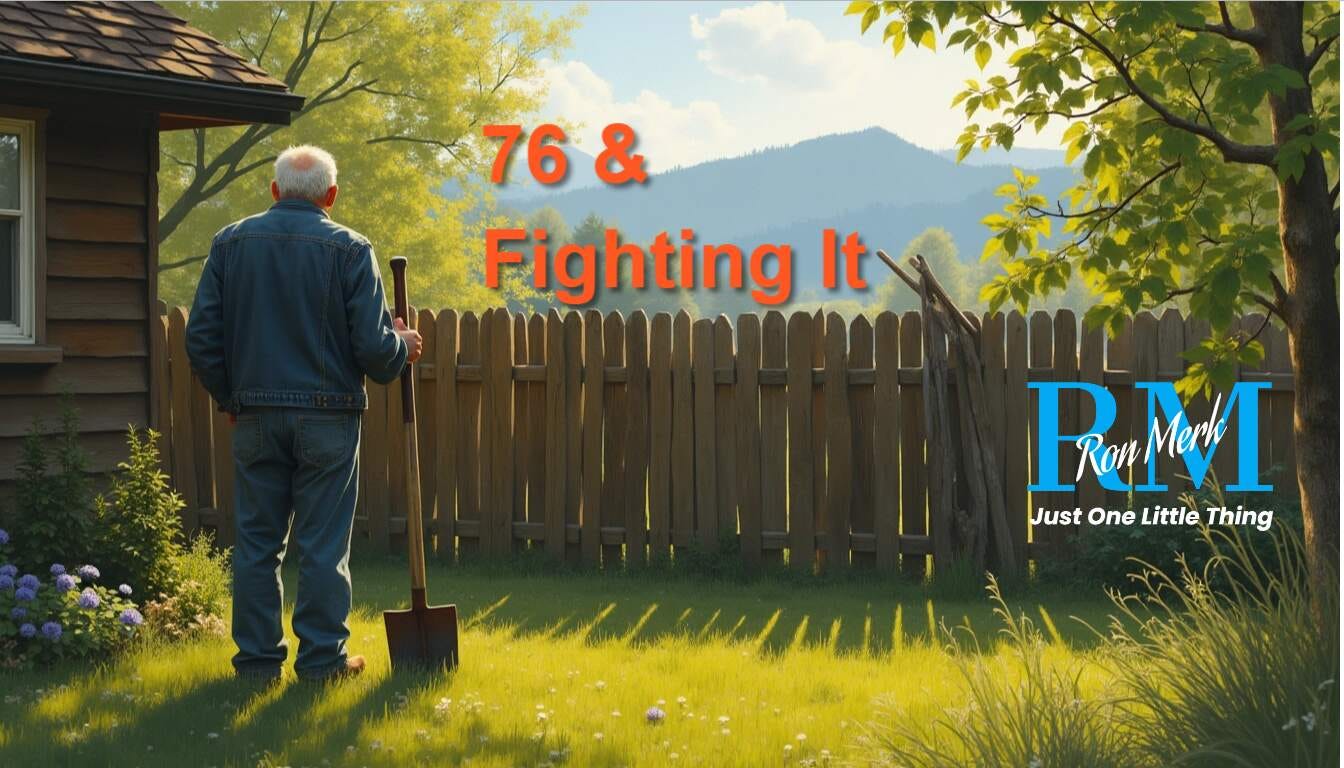
What does a storyteller do when his 76th birthday arrives? Well, let’s just say it’s an opportunity he can’t pass up.
Through his own looking glass, it’s just another Thursday… until it isn’t. A fence that’s been leaning for ten years suddenly matters, and staying busy starts to feel like a plan.
Of course, the trouble with plans is other people. By the time the day is done, it’s clear this birthday has plans of its own.
Part One: A Man With a Plan
The plan was simple. Beautiful, even, in the way that only truly simple plans are beautiful. Ron was going to fix the fence.
Not because the fence needed fixing in any urgent sense. It had been leaning at roughly the same angle for the better part of ten years, and the neighbourhood had made its peace with it. Honestly, so had Ron. But May 7th was coming. Had been coming for twelve months, the way it annoyingly always did, and Ron had decided, somewhere around the end of April, that the best possible response to turning 76 was to be so comprehensively busy with useful physical tasks that the day would simply have no room to land.
This wasn’t a new strategy. Ron had been using it, with varying degrees of success, since about his mid-fifties. The birthdays that had gone the smoothest, in his estimation, were the ones where he’d been too tired from doing something productive to sit around thinking about what the number meant. The ones that had gone the worst were the ones where he’d had too much time to think. Thinking was the enemy. Fence posts were the solution.
Peggy watched him drag his shovel and digging bar out of the shed on the morning of May 5th. Two days early, for reasons of strategic preparation. She had a look on her face that Ron had catalogued sometime in the late 1970s and never fully decoded. It wasn’t amusement, exactly. It wasn’t concern. It was something more like the expression of a person watching a weather system develop from a safe distance, knowing more or less how it’s going to go but seeing no particular reason to intervene.
‘Fence?’ she said.
‘Fence,’ Ron confirmed.
She went back inside. He started digging.
The digging went fine for about twenty minutes, which was exactly long enough for Ron to feel confident about the whole enterprise, and then his knees, which had been filing increasingly formal complaints since approximately the second Harper government, staged what could only be described as a work stoppage. Getting back upright from a crouched position beside the first post hole required a sequence of movements that Ron would not have permitted anyone to witness. A sort of staged negotiation between his hands, his thighs, the handle of the shovel, and the fence post itself, conducted in complete silence except for a sound that escaped from somewhere in his chest that was not quite a grunt and not quite a word and was entirely involuntary. He stood. He looked at the hole. He looked at the next section of fence that needed doing. He did the math.
The math was not encouraging.
He fixed one post, called it a productive morning, and went inside for coffee.
Now 76 seems like a reasonably big number. In dog years, that was 532. He didn’t pursue that line of thinking.
His reflection on reaching 76 started unintentionally. It had started as something as simple as a search for a parts number for the lawnmower, he couldn’t fully remember, but somehow, he’d ended up reading about the number 76, the way the internet occasionally ambushed you into learning something you hadn’t asked for.
Seventy-six prisoners broke out in the original jailbreak in The Great Escape, which felt personally relevant. Halley’s Comet swings around every 76 years, which meant you got to see it roughly once if you were paying attention, and Ron had, in fact, seen it back in 1986, standing in the backyard in the dark, squinting at what had turned out to be a fairly underwhelming smudge of light. There was “76 Trombones” from The Music Man, a song Ron had always found aggressively cheerful in a way he couldn’t fully trust. The Philadelphia 76ers were named after 1776, which at least meant something back then, but he’d become wholly disenchanted with it since the recent goings on in the 48 states south of Canada. The number had some dignity attached to it back then. Not so much now. Then there were Union 76 gas stations, which he had always loved, with their big orange ball sign. Dependable and round and completely indifferent to the passage of time. He closed the browser. He never did find the lawnmower part, but it did bring to the frontal lobe of his brain the immediacy of his upcoming birthday.
The thing about Ron and birthdays was that his objection wasn’t really to getting older. He wanted to be clear about this, at least in his own head, because there was an important distinction that he felt was being consistently missed by the universe. Getting older was fine. Getting older was, in fact, the only alternative to the other thing, and he had always been the kind of practical man who appreciated a straightforward set of options. You get older, or you don’t. Easy. He’d take older every time, no hesitation, no complaints.
It was the specific mechanics of getting older that were making him crazy.
The knees were just the most recent chapter in what had become a long-running and deeply unfunny serial. There was also the business with the reading glasses, which had somehow multiplied to five pairs distributed throughout the house. On the counter, by the chair, on the nightstand, somewhere in the truck, one pair whose location was a complete mystery and had been for three weeks. Yet whenever he needed a pair, every single one of them was in a room he was not currently in. He had a theory that they moved. Peggy found this theory less compelling than Ron did.
There was the thing that happened when he bent over. He didn’t know when it had started, exactly. At some point in the last few years, bending over to pick something up off the floor had acquired a sound effect. Not a dramatic sound. Not something you’d notice in a quiet room. But if you were, say, in the Beaver Creek Lumber on Gertrude St, reaching down to grab something off the bottom shelf, and there happened to be another person in the aisle, that person would hear it, and they would carefully not look at Ron. Ron would carefully not look at them, and they would all pretend the sound had come from somewhere else, possibly a small animal.
Then there were the rooms. He’d started calling it ‘the rooms,’ because it happened often enough now to deserve a name. He’d be in the kitchen. He’d think of something he needed from the workshop. He’d walk to the workshop. A distance of perhaps thirty feet, through one door and stand in the workshop with complete confidence and zero memory of why he was there. The thing he’d needed had evaporated somewhere in transit. He’d stand for a moment, doing a kind of interior search that never produced results, and then go back to the kitchen, where the memory would return immediately and with a specificity that felt almost mocking. Oh, right, he’d think. The drill bit. And back he’d go.
He averaged, he estimated, an extra quarter mile of walking per day just from this.
None of this, he wanted to be clear, bothered him in any existential sense. He was not sitting around brooding about mortality. He was fine with the general concept of mortality. Had made his peace with it years ago in the way that men who’ve grown up in working mill towns tend to do, practically and without drama. Things end. Okay. Moving on. What bothered him specifically was the indignity of the intermediate steps. The body doing its slow, undignified renegotiation of every arrangement he’d previously taken for granted. The noise when bending over. The five pairs of glasses. The thirty-foot memory gap. These were not poetic. These were not the stuff of quiet reflection by the Somass River. These were just annoying, and Ron reserved the right to find them annoying without anyone making a whole thing out of it.
Which was why the birthday had to be ignored. Because the birthday was not a celebration. The birthday was the universe’s annual reminder that the renegotiation was ongoing and, more to the point, non-negotiable. Ron had no interest in gathering everyone together to commemorate that. The fence needed fixing. That was a much better use of a Tuesday.
Peggy, to her considerable credit, had said nothing specific about the birthday in the week leading up to it. This was one of the many things Ron appreciated about fifty-plus years with the same person. She knew which hills were worth climbing and which ones she should simply watch him struggle up on his own. She had, however, been on the phone more than usual in the days preceding May 7th, and the calls had a particular quality to them: short, pleasant, conclusive, with the kind of decisive tone that meant something was being arranged that Ron would hear about when Peggy decided he should hear about it and not a moment before.
He didn’t ask. He fixed the fence. One post at a time, with adequate rest between, and with vigilance about the grunt situation that he felt was both reasonable and private.
Part Two: The Day Refuses to Cooperate
May 7th arrived at roughly the same time it always did, which Ron felt was a lack of imagination on the calendar’s part.
He was up at six-thirty. This was not unusual. His body had abandoned the concept of sleeping past seven sometime around his late sixties, and had done so without consulting him, the way it made most of its decisions now. He made coffee. He sat at the kitchen table, looking out the kitchen window at the fence. The fence posts he’d done were standing properly upright, which was satisfying. The ones he hadn’t done yet were still leaning, which gave the day a purpose. Good. The day had a purpose. He was going to finish the fence, then clean out the section of the workshop that had been accumulating a particular kind of chaos that he’d been characterizing as ‘organized’ for roughly eight years, give or take a decade or two. Then maybe walk down to Clutesi Haven and look at the boats. A full day. A normal day. A Thursday.
Peggy appeared from the bedroom, looked at him standing at the window with his coffee, took in the general posture of a man who has decided something, and said: ‘Morning.’
‘Morning,’ said Ron.
She poured herself a cup of herbal tea. She did not say happy birthday. He appreciated this enormously.
He lasted until about nine o’clock before the first crack appeared.
He’d gone out to continue the fence and crouched down beside post number three. Carefully, with premeditated attention to the knee situation, he was doing perfectly well, actually, making real progress, when his phone buzzed in his shirt pocket. He ignored it. It buzzed again. He ignored it again, on principle. It buzzed a third time, which meant it was a call and not a message, and his internal wiring, installed somewhere in the 1950s, still found it difficult to deliberately not answer a ringing phone. He straightened up. The knee sound made its appearance; a nearby robin did not react as he looked at the screen.
It was Pam, his favourite sister-in-law. They were all favourites, but they moved to the top favourite spot when he got to actually talk with them.
‘Pam,’ he said, by way of greeting that contained a complete sentence.
‘Happy birthday!’ Pam said, with the enthusiasm of someone who had seen a Facebook notification approximately forty minutes ago and had immediately acted on it, which was exactly what had happened. Ron knew this because Pam’s enthusiasm, while genuine, had the particular quality of a person who has just remembered something rather than a person who has been building toward it. There was no warm-up. It arrived at full volume. Facebook had fired the gun, and Pam had run.
‘Thanks,’ said Ron.
‘Seventy-six!’ she said. ‘How’s that feel?’
‘Fine,’ said Ron, which was the answer he’d prepared and the only one he was offering.
‘I’m going to call and let Donna know, she’s probably going to call you,’ Pam said. Now, Donna was his kind of person and a great sister-in-law. She hadn’t willingly acknowledged anyone’s birthday for the last three decades. Pam continued, ‘And Rae posted something on your wall already, did you see it?’
‘Haven’t checked,’ said Ron, which was true. He had not checked his phone since the previous evening, and he had no plans to check it today, and he was now regretting that his phone existed at all.
‘Check it!’ Pam said. ‘It’s cute.’
They talked for a few more minutes about nothing in particular. How was the weather over on his side of town versus her side? Fine. How were things generally, fine, and then Pam said she had to go and told him to have a wonderful day, and Ron said he would, and they hung up. He stood next to his fence with his phone in his hand and looked at the remaining posts and estimated he had maybe twenty minutes before Donna called.
He was back at the fence in thirty seconds. He had a system now. He was not going to look at whatever Rae had posted on his wall. He was going to finish these posts.
He finished one more before his phone buzzed again. He looked at the screen.
Donna.
Ron stared at the name for a moment. In roughly three decades of birthdays, Donna had not once called to acknowledge one. Not because she wasn’t fond of him. She was, and he of her, but because birthdays simply were not part of her operational vocabulary. She didn’t do them. Peggy always remembered hers, but everyone else’s passed without comment as far as Donna was concerned. It was consistent, at least. It was a system Ron had always quietly respected.
He answered.
‘Happy birthday,’ Donna said.
Ron stood next to his fence post in complete silence for what was probably two seconds and felt like considerably more. ‘Donna,’ he said finally.
‘Pam reminded me,’ she said, with the tone of a person offering a full and sufficient explanation.
‘Right,’ said Ron.
‘Seventy-six,’ she said.
‘Yep,’ said Ron.
There was a brief pause in which both of them seemed to acknowledge that the unprecedented nature of the call had now been mutually registered and neither of them needed to discuss it further. ‘Okay,’ Donna said. ‘That’s all.’ And she hung up.
Ron looked at his phone. He looked at the fence. He thought about the fact that Donna had just called him on his birthday for the first time in thirty years because Pam had called her, and that this was either deeply touching or a precise illustration of how the world really worked, and he couldn’t fully decide which. He put his phone back in his pocket, picked up the shovel, and decided it was probably both.
He went back to the fence. He did not look at Facebook.
The Facebook post was going to have to wait until he was emotionally prepared for it, which might never happen, and which was fine.
By mid-morning, the fence situation was as resolved as it was going to get that day, and Ron migrated to Plan B, which was the workshop. The workshop was, in one sense, a disaster, and in another sense, a completely coherent archive of every project Ron had ever started, continued, paused, or intended to begin at some future date. There was a logic to it that he understood, and Peggy had long since stopped trying to understand. This had worked out well for everyone. He moved things. He reorganized. He found three things he’d been looking for and one thing he hadn’t known was missing. He found a receipt from a hardware store dated eleven years ago, which he looked at for a moment and then put in the bin because there was nothing useful to do with it except wonder where eleven years had gone, and he wasn’t doing that today.
He was on his hands and knees behind the workbench. A position that required a specific and now-familiar exit strategy, reaching for a box of drill bits that had migrated to the back corner, when he heard Peggy come into the workshop.
‘Rodney called,’ she said.
‘Of course, he did,’ said Ron, from behind the workbench.
‘He says he has a birthday present for you.’
Ron straightened up. Carefully, in stages and looked at Peggy. ‘What kind of present?’
Peggy had the expression of a woman who had already heard this and made her own private assessment of it. ‘He wants you to come over on Saturday and help him move his hot tub.’
Ron stood with this information for a moment.
‘He wants me to help him move his hot tub,’ Ron said. ‘For my birthday.’
‘He said, and I’m quoting here, that he thought it would be good for you to get out of the house, and that you’d feel great afterward.’
‘He’s moving a hot tub.’
‘From the back deck to the side yard,’ Peggy said. ‘Apparently it’s been in the wrong spot for two years.’
‘And this is my birthday present.’
‘He also said he’d buy lunch.’
Ron considered this. Rodney had, with complete sincerity and zero apparent awareness of how this sounded, invited Ron to perform manual labour on his birthday as an act of generosity. This was so purely, perfectly Rodney that Ron couldn’t even be annoyed about it. It was almost impressive. It was a gift in the sense that it was something Rodney was giving Ron the opportunity to do, and the fact that it was primarily beneficial to Rodney was, in Rodney’s accounting, beside the point. The lunch was the bow on top.
Getting out from behind the workbench took a moment. He did not narrate this process. Peggy studied something on a shelf with great interest until he was upright.
‘Rae posted something on your Facebook,’ Peggy said, still looking at the shelf.
‘So I’ve been told,’ said Ron.
‘It’s funny.’
‘I’m sure it is.’
‘You should look at it.’
‘I’m cleaning the workshop,’ said Ron, with the moral authority of a man who has a task and is committed to it.
Peggy smiled at the shelf, which he noticed from his peripheral vision, and went back inside.
He lasted another hour in the workshop before curiosity, which was one of those character traits that had served him well his entire life and occasionally betrayed him, got the better of him. He picked up his phone. He navigated to Facebook with the wariness of a man approaching something that might be warm to the touch. He found Rae’s post.
It was a photo of him from some past family gathering or other. A good photo, actually, him laughing at something, looking more or less like himself. Above it, Rae had written: ‘Happy birthday to this man, who is currently pretending today is a completely normal Thursday. He is fixing a fence. He has been fixing this fence for three years. Love you Ron, don’t think we don’t see you.’ There was a cake emoji and a hammer emoji, which Ron felt was an accurate summary.
Forty-nine comments.
He turned his phone face down on the workbench. He looked at the workshop. He picked up a wrench that didn’t need moving and moved it anyway.
The afternoon took him into town. He needed screws. Specific screws, a size he’d run out of, an entirely legitimate errand that had nothing to do with needing to be out of the house when whoever called next called. He drove up Johnston Road with the windows down, which was one of the better things about a Port Alberni day in early May, when the valley has finally shaken off the grey, and the mountains are doing that thing where they look closer than they actually are. He parked and went into the Home Hardware store.
He was in the fasteners aisle. This was the aisle he needed; he was there for a reason. A purposeful errand that couldn’t wait for another day. When he crouched down to read the label on a box of deck screws on the bottom shelf, the sound happened. It was not loud. It was, if anything, quieter than usual. But the man two metres down the aisle, who was perhaps fifty, who was reading a box of bolts with the concentration of someone who knew absolutely nothing about bolts, heard it. Ron could tell because the man’s shoulders moved in a very specific way that meant he was performing the not-having-heard maneuver.
Ron stood up. He took the screws. He went to the counter, paid and exchanged a few words with the young woman at the till, who did not say anything about his birthday because she did not know it was his birthday, because she was twenty-four and had better things to think about, which Ron found deeply refreshing. He said thank you. She said have a good one. He went to his truck.
He drove down to Clutesi Haven Marina because he’d said he would and because the Inlet in the afternoon was one of those things that worked on him in a way he couldn’t always explain but had stopped trying to explain, which was itself a mark of getting older that he didn’t entirely object to. He sat in his truck for a while and looked at the water. A heron was doing something methodical near the shore. The mountains across the Inlet were lit up in the afternoon way, the shadows going long in the valleys between them. He didn’t think about his birthday. He thought about Saturday and whether he was actually going to help Rodney move that hot tub, and concluded that he probably was, because that was the kind of thing you did, and also because Rodney would buy a decent lunch and complain entertainingly the entire time, which was its own form of recreation.
He drove home. He was, all things considered, winning.
~ ~ ~
Part Three: Checkmate
Dinner was good. Peggy made the chicken. The specific chicken, the one with the thing she did to it that Ron had never been able to get her to fully explain, which he suspected was intentional. They ate at the kitchen table and talked about whether the gutters on the back of the house needed doing before the summer, and at no point did either of them say the word birthday, which suited Ron down to the ground. This was a good dinner. This was a Thursday dinner. This was exactly the kind of evening a man had when he was just living his life and nothing particular had happened.
He helped clear the table, which involved bending over to pick up a fork he’d dropped, and the sound made its appearance for the second time that day. Peggy said nothing about it. Nor did Ron, and they both moved on immediately, which was one of the quiet understandings that accumulates across a long marriage, like sediment in an old river. Not discussed, just there, load-bearing.
After dinner, he settled into his chair in the living room. The chair was a specific chair that had been correctly positioned relative to the television and the lamp for long enough that Ron no longer thought about it. He just lowered himself into it, which took a moment, with the careful deliberateness of a man who has learned that his relationship with furniture now requires some negotiation. He found the remote. He turned on the television. He felt the particular satisfaction of a man who has worked his way through a full day and is now horizontal and entitled to be.
Seventy-six, he thought, and then caught himself thinking it and stopped.
Peggy came in and sat in her chair and said ‘good day?’ in the easy offhand way of a person who already knew the answer, and Ron said ‘yes, it was a good day’ back, and that was that. She took back the remote, which had been her domain for the last forty years.
He watched television for a while. The news, then something else, then something he wasn’t fully paying attention to. His eyes were doing the thing they’d started doing in the evenings, where they would suggest, quietly but persistently, that the current hour was later than the clock said. He was not tired. He was comfortable, which was different from tired, but the distinction was becoming increasingly philosophical.
He decided he needed a glass of water.
He got up. This took a beat; the chair required an exit approach, and went to the kitchen. Filled a glass and stood at the counter, drinking it and looking at nothing in particular, the way you look at nothing at the end of a day. The kitchen was quiet. The house had its nighttime sounds, the settling of things, the hum of the fridge, the occasional tick from wherever it was that houses ticked.
He finished the water. He put the glass down.
He walked back toward the living room, and as he passed the hallway mirror, the one that had been on that wall since sometime in the previous century, he caught himself in it. Not deliberately. He wasn’t a man who stopped to look at himself in mirrors; he found mirrors largely informational and not always delivering information he’d requested. But he caught himself at exactly the wrong angle, in the specific way that hallway mirrors in the evening will do if you’re not careful, and for just a second he saw himself as he actually was.
Balding with white hair on the sides. Comfortably worn. Moving through his own house at the end of a Thursday in May with the slightly careful gait of a man who has learned to think about stairs. A man who made sounds when he bent over and had five pairs of glasses and an extra quarter mile of walking per day built into his routine. A man who had spent the entire day treating the 7th of May like a Thursday, with such commitment and such effort, that the effort itself had become the story.
He stood at the mirror for a second. Just a second.
Then, quietly, without planning to, he laughed.
Not a big laugh. Not the kind that needed explaining. Just a short, private, acknowledging kind of laugh. The kind you make when you’re the only person who’s in on the joke, which he was, mostly, except for Peggy, who was in on all of them. The kind of laugh that comes when you’ve been trying very hard not to see something, and then you see it anyway, and the gap between the effort and the result is ridiculous enough that you can’t do anything but laugh at yourself.
Seventy-six.
He said it in his head, and it didn’t feel any better than it had that morning. But it felt different. It felt like the number of a man standing in his own hallway at the end of a day he’d largely outmaneuvered, with a fixed fence and a cleaner workshop and screws he’d needed and a look at the Inlet and a good dinner and moving a hot tub on Saturday and Peggy twenty feet away in the living room, which was where she’d been, more or less, for fifty-some years.
He walked back into the living room. He settled back into his chair, which took the usual moment.
‘What’d you laugh at?’ Peggy asked, not looking up from her book.
Ron looked at the television. ‘Mirror,’ he said.
Peggy turned a page. ‘Mm,’ she said, in the tone of a woman who had been expecting something like this and was unsurprised by its timing.
They watched television for another hour. The valley outside was dark now, the mountains invisible in the night, their presence something you knew from memory rather than saw. Somewhere in the Inlet, the water was doing its slow tidal thing, indifferent and consistent and old in a way that made seventy-six look like a rounding error. The heron was probably still out there, doing something methodical in the dark, as herons did.
Ron’s eyes were making their suggestions again. He didn’t fight them this time.
‘Bed,’ he said.
‘Go ahead,’ said Peggy. ‘I’ll be in.
He got up. He turned off his lamp. He got as far as the doorway to the hall and then stopped, for no reason he could fully articulate, and looked back at Peggy in her chair, reading, the lamplight on her, completely at home in this house and this life and this evening.
He didn’t say anything. She didn’t look up. He went to bed.
He was asleep by ten, which was the earliest he’d been asleep on his birthday in years, and the best he’d felt about it in longer than that.
He also knew folks weren’t finished with his birthday, with the quiet certainty of a man who has lived among these particular people for a very long time, that Thursday was not the end of it. Saturday was coming. There would be the hot tub. Rodney’s hot tub, Rodney’s side yard, Rodney’s idea of a birthday gift, and then afterward, because these things had a way of becoming other things, there would be a BBQ in Ron’s backyard. With Ron’s people. Eating Ron’s food, cooked by Ron, at Ron’s grill, on the occasion of Ron’s birthday, which Ron had spent an entire Thursday pretending did not exist.
He would be the one manning the grill. This had not been discussed. It didn’t need to be discussed. It was simply how the physics of the situation worked. Put Ron near a barbecue and the universe self-organized around that fact. He’d be the one watching the grill, timing the burgers, telling someone their chicken needed another four minutes, whether they thought so or not. The birthday boy, spatula in hand, feeding everyone who’d shown up to celebrate with him.
He thought about this for a moment in the dark of the bedroom, on the edge of sleep.
Honestly? That part he was actually looking forward to.
Seventy-six, he thought. And closed his eyes.
~ ~ ~
— End —
A Canada Far West Story • Port Alberni, British Columbia
Happy birthday to you my friend…. Ahhh yes 76 … I remember it well lol